

Can you take your young bonsai cuttings outside?
The complete guide to helping your mini-bonsais reach the light
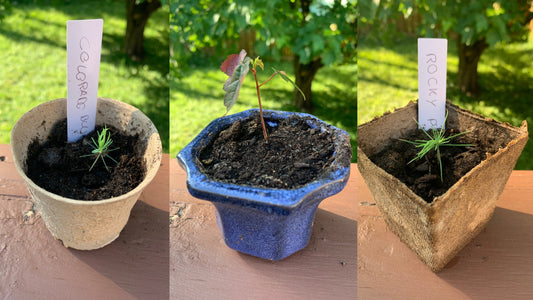
You carefully sowed your seeds, impatiently awaited the first leaves… and here they are, your young bonsai seedlings. Fragile, still shy, but very much alive. Now what? Should you let them grow indoors? Or can they already enjoy the fresh air and sunshine of the garden or balcony?
At Ikigai Box, we are often asked this question. The short answer: yes, you can take your young seedlings outside, but not just however you want. The outdoors offers many advantages, provided you introduce this new world gently. In this article, we will guide you step by step on how to take your young seedlings outside at the right time and under the right conditions.
1 | Why take your young seedlings outside?
There are many advantages to taking your young seedlings outside, here are the 3 main ones!
Natural sunlight, real fuel for your plants
Even if your bonsai grows very well behind a window, nothing can replace direct sunlight. Natural rays promote more efficient photosynthesis, which stimulates growth, chlorophyll production, and stem strength.
Unlike light filtered through glass, outdoor sunlight truly strengthens the vitality of your young trees, giving them a brighter color and better resistance to variations in light.
Wind, a trainer for the trunk
Did you know? Wind is an important factor in trunk development.
When your young seedlings are exposed to wind (light to moderate), they learn to stabilize themselves, which stimulates the production of lignin, a substance that gives wood its rigidity. Result: a thicker, straighter, and stronger trunk. A faster "bonsai" look.
It is a key step to start shaping a balanced bonsai from the very first months.
Better immune system stimulation
Plants that live exclusively indoors can become more susceptible to fungi and pests due to the lack of variability in their environment. Regular outdoor time allows them to harden off and develop better natural defenses against the hazards of outdoor life.
An important reminder: your bonsai seeds are… tree seeds
Even if you grow them with the idea of obtaining miniature trees, your young seedlings come from seeds of real species (maple, black locust, pine, etc.). These trees are made to live outdoors! What makes them good bonsai candidates are qualities like their tolerance to pruning, their slow growth, or their adaptability, not their fragility.
In short: if the climate allows, your young seedlings will be happier outdoors.
2 | When can you take them outside?
Taking your young seedlings outside is an excellent idea… but not too early. These little living beings need time to adapt, like a baby that is not immediately exposed to the sun or cold.
Wait until the seedling has fully emerged
Generally, you can consider taking them outside about 2 to 3 weeks after germination, once:
- the seedling is straight and measures at least a few centimeters,
- the first leaves (or needles) are well formed,
- the plant looks vigorous and stable in its substrate.

The golden rule: temperature
Above all, check the weather. Your young seedlings grew up in a stable environment, often around 20°C, as recommended in our Bonsai Box.
Do not start taking them outside if it is less than 15°C outdoors during the day, especially if the temperature difference with the indoors is significant. Thermal shock could be fatal to them. Likewise:
- Avoid taking them out in case of strong wind, heavy rain, or cold nights.
- Prefer a period of mild, stable, and dry weather, in spring or early summer.
Gentle adaptation: follow the Ikigai method
Taking a seedling outside is not all or nothing. You must gradually accustom it to its new environment. Here is our tested and proven method:
Day 1 to 2: a few hours in the shade
Choose a shaded corner, sheltered from the wind, on a balcony or in a garden. Leave your seedlings there for 2 or 3 hours during the day, then bring them back in.
Day 3 to 4: half a day in the shade
Extend the exposure time to half the day. Check that the soil remains moist.
Day 5 to 6: a little direct sun
Expose your plants to direct sunlight, but only for half a day. Observe their reaction: if the leaves remain turgid, that is a good sign.
Day 7 and +: a full day outdoors
From the second week, if the weather allows, your seedlings can stay outside all day — and even spend the night there if the temperatures do not drop too low (minimum 15°C).
Don't forget: watering is crucial!
Outdoors, evaporation is stronger, especially with wind and sun. It is essential to keep the soil constantly moist. Not soaked, but moist.

A simple little tip: touch the soil every day. If it feels dry on the surface, water it without delay.
Signs that your seedling is doing well (or not)
Observing your young seedlings every day is the best way to detect if the move outdoors is working for them. Here are the indicators to watch:
✅ Good signs
- The stem remains straight: this is a sign of vitality and strength.
- The leaves (or needles) are well opened and a clear green: this is a sign that they are receiving enough light without being burned.
- The seedling thickens slightly: this is the beneficial effect of light wind, which stimulates the trunk.
- No wilting at the end of the day: this means that the plant is not too hot or too thirsty.

❌ Warning signs
- The leaves turn yellow or brown: this can indicate sunburn or a lack of water.
- The seedling sags or leans: it may be weakened by wind or a lack of humidity.
- Spots appear: this can be due to overwatering or a fungus (be careful with prolonged rains).
- Growth is frozen for more than two weeks: it may be time to bring the plant back inside and place it under observation, or to repot it.
Conclusion: nature is their playground
Taking your young bonsais outside is offering them a stimulating and natural environment. Sunlight, wind, and slight temperature variations are powerful allies to help them become stronger and more balanced.
But be careful: like any learning, it requires gentleness and patience. Adaptation does not happen overnight. By following the recommended steps, you will avoid shocks and maximize their chances of developing into magnificent miniature trees.
Remember: a bonsai is a tree. And trees, by nature, like to live outdoors.
🌱 Want to go further?
With the Bonsai Box, you receive everything needed to grow three amazing species of miniature trees from seeds. Each seed has been selected for:
- its ease of germination,
- its tolerance to climatic variations,
- its ability to become a magnificent bonsai.
📦 Free shipping anywhere in Canada
🎁 An original, meditative, and 100% Canadian gift idea.
👉 Order your Bonsai Box here


1 comment
merci tres bien documenter